The UC Davis Good Life Garden blog has moved!
You should be automatically redirected in 5 seconds. If not, visit
http://goodlifegarden.ucdavis.edu/blog
and update your bookmarks.

Thursday, March 17, 2011

We've moved!

To try and simplify things a little and to get with the times, we have integrated our blog and website! From now on you can find our blog here:

http://www.goodlifegarden.ucdavis.edu/blog/

Thanks so much for reading!
 

Tuesday, March 15, 2011

Does sprinkling tomato plants with seawater increase their nutritional value?

by Zuhayr Mallam, founder of the UC Davis Diabetes Advocacy and Awareness Group (DAAG). For more information about this group, visit their website.

Tomatoes are among the most popular items in American gardens today and are commonly used in many types of salads and sauces. They have an especially rich history at UC Davis (see the “square tomato” and other tomato research on campus) and thrive in the Sacramento Valley, due to the prime tomato-cultivating summer climate.
Image taken from the Gillaspy Lab webpage at Virginia Tech University
Tomatoes are high in antioxidants, which are thought to help fight cancer, prevent heart disease, slow aging, and confer a host of other health benefits. And although it has been long held that salt is harmful to soil, several studies conducted worldwide have shown that spraying tomato plants with diluted – approximately 10% saline – seawater can actually increase their nutritional value and taste! The salt in seawater is thought to produce stress in tomato plants, which respond by producing more antioxidants, such as Vitamin C, Vitamin E, and chlorogenic acid, as well as other taste-enhancing chemicals – albeit it makes the fruit somewhat smaller. Many are still concerned about salt causing soil degradation and rendering some seawater-treated tomatoes inedible, but scientists cite that plants thrive in balanced soil containing both macro– and micronutrients.

This theory is still much up in the air, but it is good food for thought. A major potential benefit of this method would be providing irrigation for crops in areas with freshwater restrictions and shortages as well as malnourishment.

Hmm… This may be an interesting opportunity for a summer science experiment! Let us know if you decide to give it a try.

As always, consult a medical professional before making any changes to your lifestyle or diet!

Monday, March 14, 2011

"I saw the sign..."

...and it opened up my eyes... to all the different types of trellises involved in viticulture!

If you haven't gone by the garden recently, check out the new sign we've installed that provides some great information about the awesome teaching vineyard on the west side of the RMI.


If you can't make it to the garden, click here to view a larger pdf.
Or if you just want a few tidbits, here are some fun facts:
  • There are eight different areas or "blocks" of grape vines in the new vineyard dedicated to different donors, trellising systems, and types of grapes.
  • There are many different trellis types and trellising techniques based on a variety of factors such as grape variety, climate, and method of harvest.
  • The Harry E. Jacob Variety Demonstration Block in the Teaching Vineyard is a reference collection featuring over 300 of the world's major grape varieties and is arranged by country, region and variety.
  • Ampelography is the area of botany that identifies and classifies grapevines.  It means "grape vine identification" in Greek.  Students are trained in the Ampelography block which features examples of the most widely-planted wine grapes in California.
  • The vineyard also includes a table grape block featuring current and historic grape varieties not used for wine such as Crimson Seedless, Autumn Royale, Malaga and Muscat of Alexandria.
And just in case you don't know:

Vi•ti•cul•ture - n. : the cultivation or culture of grapes
Enol•o•gy - n. :a science that deals with wine and wine making
(from the UC Davis Viticulture and Enology website)

Visit the UC Davis Viticulture and Enology Program website for more info as well!

Friday, March 11, 2011

A Beautiful Friday in the Garden

APHID UPDATE: The aphids have now moved on to cabbage and chard and Pat is fighting what seems to be a losing battle! She said that with the advent of the warmer weather and sunshine that the aphid population seems to be exploding. Her advice: just be diligent and continue spraying with the Safer Soap as much as possible, as well as following the other tips from our previous post.   And pay attention to all of your tasty leafy veggies - not just kale- because they are definitely not immune either!

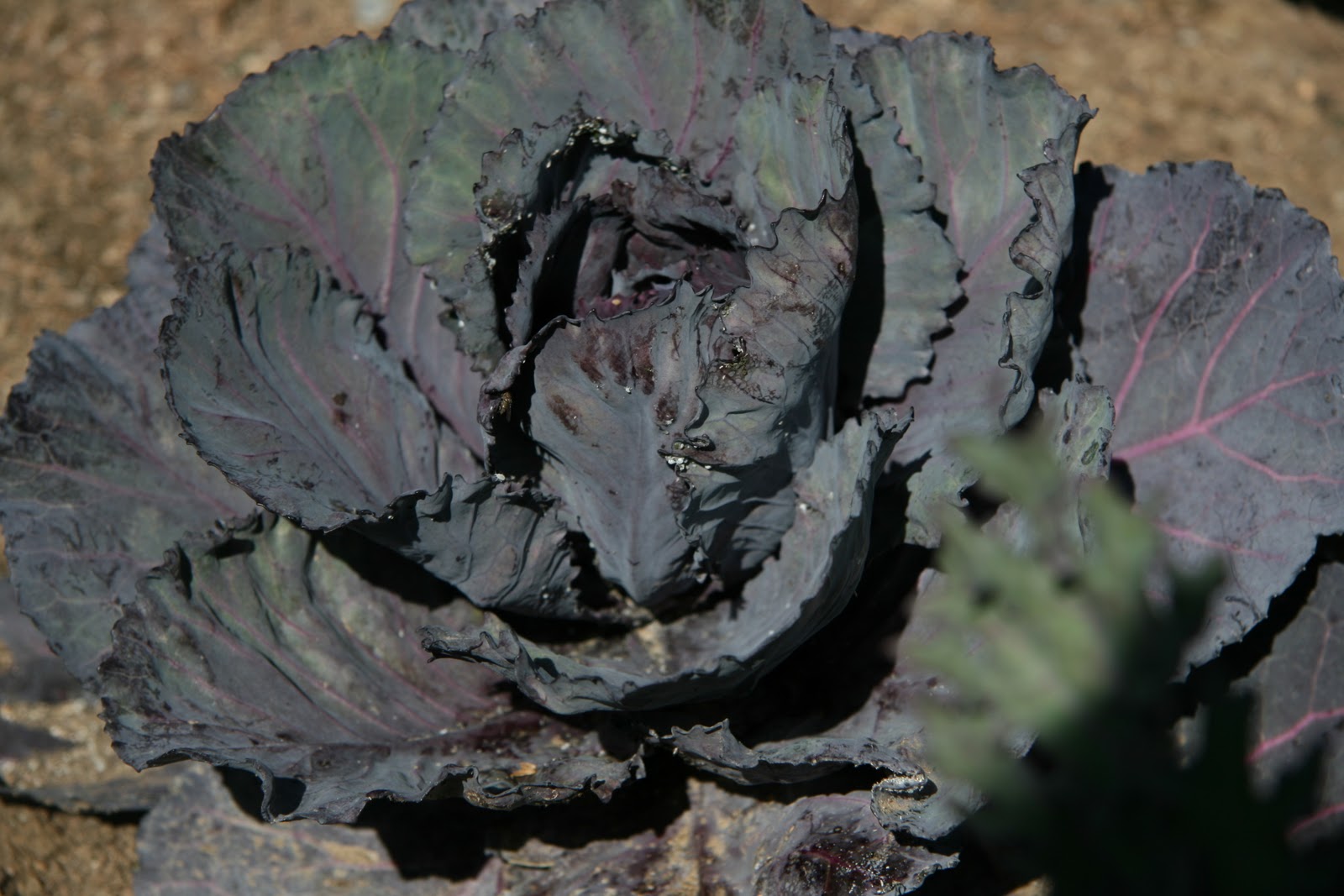
Yep... the aphids have gotten to the cabbage.  Now that's nasty!

This poor little kale plant was stunted from all of the aphid damage!


Other than the bad news on the aphid front, everything else in the garden is doing well and it is a beautiful sunny day! The artichokes are sprouting, the calendula adds a vibrant touch of orange all over the garden, and the newly planted radishes and nasturtiums are starting to sprout!  Enjoy some recent photos below and have a great weekend!

The calendula is spectacular right now!

Now I want a Greek salad!
 

Maybe the chard is starting to have an aphid problem too, but it is all over the garden and still looks delicious to me!

The purple hues of the kale and cabbage complement each other nicely, don't you think?
Pat is working diligently away at spraying the kale with the Safer Soap to rid it of aphids.
Go, Mr. Ladybug, go!  Eat those aphids so I can eat this delicious artichoke.
Ok so these aren't in the garden, but are so spectacular I had to share them anyway.  The tulip trees on campus are breathtaking right now!

Wednesday, March 9, 2011

Spring Gardening Tips

Spring is almost here!  The vernal equinox is on March 20 and marks the beginning of spring in the northern  hemisphere.  Here are some gardening tips to get ready for the season from "The Yolo Gardener" Spring 2011 Newsletter--a quarterly publication by the UC Yolo County Master Gardeners, by Master Gardener Linda Parsons. Thank you Linda for these great tips!

Yum!  Can't wait for peaches this year!  Make sure to get out there and trim and treat your fruit trees before buds swell.  Image from edenbrothers.com.
SPRING CLEANING
  • Prune foliage and branches damaged by winter.  If you haven't yet pruned your roses and fruit trees this is the last month to get them ready for spring bloom.  Don't put it off any longer!
  • Take care of weeds now before they take over.
  • Remove old growth from perennials and dig and divide crowded plants. 
     FERTILIZING, COMPOSTING and MULCHING
    • Begin cultivating your perennials - loosening soil once it is dry enough - and add soil amendments such as compost, peat moss and organic fertilizer. 
    • Be sure to use fertilizer recommended for each plant type.  Too much nitrogen will make plants grow too quickly, producing weaker growth.
    • Care for roses and fruit trees by adding rose food and soil amendments, as well as a cup of alfalfa pellets and two tablespoons Epsom salt to each rose plant.  This will help the roses produce more basal breaks (new growth) and chlorophyll.
    • Mulch your garden to a depth of 3 inches to reduce weeds and require less watering.
      PLANTING
    • Start your plant selection: 
      • Pansies, violas, Dianthus, Iceland poppies, primroses and plant candytuft are all early blooming annuals.  
      • Bulbs, corns and tubers like cannas, begonias, lilies and dahlias can be planted now.
      • Some good shade plant selections include astilbe, columbine, coral bells, Dicentra, Foxglove, Hostas, Nepeta, Pulmonaria and ferns.
      • Primroses are one of the earliest spring flowers, and are often a common sight at Victorian cottage-style gardens. Image from hortmag.com
      • A good drought tolerant selection can include Russian sage, Muhlenbergia, rabbit's tail grass, Buddleia, echinacea, rudbeckia and gallardia.
    • Remember to lightly fertilize and mulch after planting!  Plants will do better if they are planted at or slightly above grade.
    Rabbit or bunny's tail grass is a great drought-tolerant selection, and it's cute!  Image from lilacsandroses.blogspot.com.
      DISEASE AND PEST CONTROL
      • Due to above average rainfall, there are going to be more insects and diseases this year, so keep an eye out for early fungal diseases and aphids.
      • March is your last opportunity to spray fruit trees with dormant (lime-sulfur) spray before buds swell to get rid of wintering fungus and spores.
      • Check plants regularly (especially roses) for black spot, rust and mildew.  Also check for slugs, snails and earwigs, as well as aphids, mites thrips and scale with the advent of warmer weather.  Keep these harmful insects in check by planting yarrow, alyssum, feverfew, dill, parsley, coriander, penstemon and asters to attract beneficial insects.
      • Visit ipm.ucdavis.edu if you want to use commercial pesticides.
      LAWN CARE
      • Check your irrigation system to make sure your lawn is getting enough water.  Increase the water amount as the days get longer and warmer.
      • Re-seed thin areas and begin your fertilizing and mowing schedule.  Try applying a light topcoat of compost to improve lawn growth and health.
       MAINTENANCE
      • Stake tall growing perennials and vegetables before they start bending over in late spring.
      • Later on in the season thin fruit trees, leaving four to five inches in between each fruit to help remaining fruit mature properly and to keep branches from being over-weighted which can cause splitting.
      • Deadhead spent flowers to ensure a long blooming season.
      • Plant containers with annuals and herbs.
      To read the unabridged version of this article go to their website and download the Spring 2011 newsletter here.  You can also sign up to receive this newsletter by entering your email address at the top of this page.

        Tuesday, March 8, 2011

        FREE Gardening Classes from Local Experts!

        Gardeners and wannebe gardeners!  Mark your calendars!  Here is a list of FREE classes being offered by our local area Master Gardeners!  I can taste the freshly picked produce now...yum!


        SOLANO COUNTY
        Worm Composting
        Date: March 17, 2011
        Time: 7 - 8 PM
        Location:  Vacaville Library Cultural Center
        1020 Ulatis Drive
        Vacaville, CA
        more info...

        Vegetable Gardening Seminar
        Highlights: How to start a vegetable garden with information on seeds, transplanting, irrigation, double-digging and composting.
        Date: March 26, 2011
        Time: 10 AM - 12 PM
        Location:
        Benicia Community Garden
        E. 2nd St. and Military East
        Benicia, CA
        (Behind the Heritage Presbyterian Church)
        more info...

        Sustainable Landscaping Seminar
        Date: April 16, 2011
        Time: 1 - 3:30 PM
        Location:
        Solano Community College
        Horticulture Building 1000
        4000 Suisun Valley Road
        Fairfield, CA
        more info...

        YOLO COUNTY
        Spring Plant Sale and Gardening Workshop 
        Highlights:  Plant sale, basic vegetable gardening & tomato growing tips
        Date: April 2, 2011
        Time: 9 AM to 1 PM
        Location:
        Woodland Community College Horticultural Center
        2300 East Gibson Road
        Woodland, CA
        more info...

        Got Allergies?  Plants to Consider Using in Your Garden
        Date: April 9, 2011
        Time: 9:30 AM - 10:30 AM
        Location:
        Meet at the Central Park Gardens in Davis at 4th and C Streets
        more info...

        Backyard and Worm Composting
        Date: April 16, 2011
        Time: 9 AM - 11 AM
        Location:
        Woodland Community College Horticultural Center
        2300 East Gibson Road
        Woodland, CA
        more info...
        Still need more information about any of these events?  Contact the Master Gardener secretary at 530-666-8143.

        Monday, March 7, 2011

        2011 is the Year of the Vegetable!


         2011 has been named Year of the Vegetable by Mr. George Ball, president of the W. Atlee Burpee Company.  (The cynic in me thinks, well isn't that convenient...you sell vegetable seeds, so why not make every year "Year of the Vegetable," right?)  But I read on to become inspired!  Here is a quote from the newsletter:
        Eighteen years ago as president of the American Horticultural Society, [Mr. George Ball] initiated a successful children's gardening program. He now wants to inspire all of America to at least develop a starter garden. A recent study by the Centers for Disease Control shows that only 26 percent of Americans eat at least three servings of vegetable a day. With child obesity at an all-time high, Mr. Ball advocates a nutritional diet with lots of fruits and vegetables. It has been found that kids who grow vegetables alongside their parents eat them regularly and with gusto.
        Not too shabby, eh?  My nephew is five and I don't believe he has ever willingly eaten a vegetable.  My sister sneaks vegetable nutrients into his 'milkshakes' in the morning.  This has kept him incredibly healthy, active, fit, and smart as a whip, but I wonder if he would be more into eating his veggies if he grew some on his own.  I'm going to get him started on this project when I go down to SoCal for a visit in April.

        Do you have kids who grow their own fruits and vegetables?  Do you agree with Mr. Ball's assessment?  Tell us your stories!

        Friday, March 4, 2011

        Aphids Attack Kale, Leave Chard Alone?

         We've got some aphid issues in the garden.  Do you?  The weird thing is that they are going after kale, but not chard or other greens, any idea why?


        It is kind of hard to see, but here Pat is showing me how deep the aphids can get into our crops...kale in particular seems popular with the pests this year!

        Here is a photo of the damage that aphids can wreak on your edibles.  This was kale!

         After talking with Pat Stoffel, UC Davis Good Life Garden gardener extraordinaire, she pointed out this odd occurrence and spoke about how she manages aphids by using Safer Soap.  The problem with this method is that it takes a long time to go through each plant under attack and it only eliminates aphids currently feasting on our greens.  Other than that, there doesn't seem to be a whole lot else one can do to fight these buggers long term.

        Below is some information you may find helpful in controlling aphids in your garden.  This text is edited from "The Yolo Gardener" Spring 2010 Newsletter--a quarterly publication by the UC Yolo County Master Gardeners.  Thank you to Master Gardener Barbara Ohlendorf for this very informative article!

        Here are my cliff notes to aphid control based on her article:
        • It is hard! (Brilliant observation, right!)
        • Aphids are annoying and they have lots of little friends that help them out.
        Control methods:
        • Hose down the affected plants that are hosting colonies every few days
        • This won't get rid of them all, but you want to keep some aphids around so that their natural enemies, like ladybugs, stick around.
        • Where you have aphids you probably also have ants that protect the aphids from their natural enemies.  Why? Because ants like to feed on aphid honeydew. (Honeydew is a euphemism for the aphid spit that these bugs excrete in order to chow down on your plants.)
        • You will need to get into the ant 'elimination' business as well. 
        • Consider using an organic insecticide like Safer Soap (See above.) to manage the population without damaging your plants or destroying your garden's eco-balance.
        To read the unabridged version of this article go to their website and download the Spring 2011 newsletter here.  You can also sign up to receive this newsletter by entering your email address at the top of this page.

        UC Integrated Pest Management Information
        NEED MORE?  Attend this FREE Public Education Class
        The Whys and Hows of Integrated Pest Management
        Time:  March 12, 2011 at 9:30 AM
        Place:  Central Park Gardens, 3rd and B Street, Davis, CA

        Wednesday, March 2, 2011

        BEWARE: Silly String Attack!

        Silly string?  NO!  Citrus trees beware!  This highly invasive parasitic plant attacks and grows over ornamental shrubs and fruit trees with a preference for citrus, but its non-discriminating taste also includes annuals, perennials and native trees such as oaks and willows.   This mess of thick spaghetti with leafless twining threads, wraps around host stems to form a dense mat; if it doesn't kill the host, the weakened state of the infected plant will predispose it to diseases, insects and nematode invasions.

        This weed is under an eradication program in California and has spread to more than a dozen California counties including Alameda, Butte, Contra Costa, Fresno, Los Angeles, Merced, Sacramento, Shasta, Solano, Sutter, Tulare, Yolo, and Yuba. It has also been a major problem in Texas.

        WHAT DO YOU DO IF YOU SEE THIS?  Do not try to control it yourself.  Report it to Yolo County Agricultural biologist Bill Lyon at 530-666-8140.  Curious?  Find out more about this weed on the UC Davis IPM website.

        Thank you to the University of California Cooperative Extension Yolo County Master Gardeners for shedding some light on this parasite.  This content is paraphrased from a Spring 2011 feature by Diana Morse appearing in their newsletter, "The Yolo Gardener."  

        To check out some of their past issues, go here.  Interested in signing up to receive quarterly news via email from this wonderful resource, enter your address into the box at the top of the page.

        Monday, January 24, 2011

        SWEET BAY LEAVES--Deceptive Name, Delicious Addition


        Image source: www.newyoungworld.com
        The Bay Leaf, found on Bay Laurel evergreens and shrubs throughout Europe, North America, and India, has become a staple of Mediterranean cuisine and serves as a healthy and delicious supplement to any diet.
        Contrary to its deceptive nickname – “Sweet Bay” – the Bay Leaf is actually intensely bitter and may even be harmful if ingested whole due to its razor-sharp edges. However, it has become quite a popular food additive due to its exotic flavoring, olfactory appeal, and long shelf-life (one year!). Most often, it is ground up and used in spicy dishes, such as biryani (see recipe below), or boiled in soups, sauces and stews. Many are also attracted to its distinctive scent, which can brighten any meal!
        Bay Leaves are an excellent choice for type 2 diabetics, because they help the body process insulin more efficiently, therefore lowering blood sugar, and reduce cholesterol and triglyceride levels (diabetics are at higher risk for developing cardiovascular disease). Additionally, they have been used throughout history to cure migraines, bacterial and fungal infections, indigestion, and much more!

        Try this Recipe for… Biryani
        A spicy Persian/South Asian Dish

        Image source: quick-recipes-online.blogspot.com
        Ingredients:
        -2 lbs. Chicken with bones (cut into small pieces)
        -2 cups Basmati Rice (washed)
        -1 packet Shan Special Bombay Biryani Mix
        -2 tablespoons crushed garlic
        -2 tablespoons cup plain yogurt
        -2 tablespoons grated ginger
        -1/2 onion (finely sliced)
        -1 tomato (cut into small pieces)
        -5 tablespoons oil
        -3 medium potatoes (peeled & halved)
        -Water
        -Crushed bay leaves

        Preparation:
        1. Fry the onion in hot oil until golden. Add tomatoes and fry until the oil separates.
        2. Add meat, garlic, ginger, potatoes, yogurt, bay leaves, and Shan Bombay Biryani Mix. Fry for 15 minutes.
        3. Add 1-2 cups of water and cook on low heat until the meat is tender. Then increase the heat and stir fry until oil separates from the gravy.
        4. SEPARATELY, boil the washed rice in 12 glasses of hot water. Boil until the rice is more than half cooked. Remove from heat and thoroughly drain the water.
        5. Spread the cooked meat and curry over the rice in TWO layers. Cover the pot and cook on low heat until the rice is fully cooked and tender. (Approximately 30 minutes) Mix before serving.
        *This recipe serves 6-8 people

        by Zuhayr Mallam, Founder of the UC Davis Diabetes Advocacy and Awareness Group (DAAG).  

        Monday, January 10, 2011

        Eggplants -- The "Mad Apple"


         by Felix Munoz-Teng, Vice President of the student-run, UC Davis Diabetes Advocacy and Awareness Group (DAAG).
        When Europeans first encountered the eggplant, they gave this delectable food a rather dark nickname – mala insane or “mad apple/egg” – because it comes from a family of poisonous plants. Although this dreary name stuck, people quickly realized the eggplant’s tremendous health benefits, and it became a staple crop of the Mediterranean.
        Nutritional Value 
        Although eggplants have an unflattering reputation, they deliver a wide variety of vitamins and minerals, including Thiamine, Vitamin B6, Vitamin C, Vitamin K, Folate, Niacin, Pantothenic Acid, Copper, Manganese, Magnesium, Phosphorous and Potassium. Wow! They are also a good source of fiber, which is found in the skin, and are low in sodium and overall calories.
        Health & Disease
        Eggplants contain bioflavonoids, which may be helpful in preventing strokes and hemorrhages. They also contain an antioxidant known as phytochemical monoterpene, which may be beneficial in preventing heart disease and cancer. The National Cancer Institute is currently conducting research to determine whether they may help with the inhibition of steroidal hormones that stimulate tumor development.
        However, the fruit contains some negative toxins like solanine, which may be harmful to some individuals. Solanine is an alkaloid that can result in heart failure, headaches, diarrhea, and vomiting if ingested. Be sure to check with your doctor to see if you are sensitive to this toxin before consuming large quantities of eggplants.
        And remember! Eggplants can be found at the UC Davis Good Life Garden!
        Try This Recipe for…Baba Ganouj – A Delicious Dip (brought to you by Eating Well Magazine)


        Ingredients:
        • 2 medium eggplants, (1 pound each)
        • 4 cloves garlic (unpeeled)
        • 1/4 cup lemon juice
        • 2 tablespoons tahini
        • 1 1/4 teaspoons salt
        • Extra-virgin olive oil (garnish)
        • Ground sumac or chopped pistachios (garnish)
        Preparation:
        Prick eggplants all over with a fork. Thread garlic cloves onto a skewer. Grill the eggplants, turning occasionally, until charred and tender, 10 to 12 minutes. Grill the garlic, turning once, until charred and tender, 6 to 8 minutes. Transfer the eggplants and garlic to a cutting board. When cool enough to handle, peel both. Transfer to a food processor. Add lemon juice, tahini and salt; process until almost smooth. Drizzle with oil and sprinkle with sumac, if desired. Enjoy!
        This blog was brought to you by the Diabetes Advocacy & Awareness Group (DAAG)

        Tuesday, December 14, 2010

        Pomegranates – A Healthy Winter Snack


        by Zuhayr Mallam, Founder of the UC Davis Diabetes Advocacy and Awareness Group (DAAG).  For more information about this group, visit their website.

        Pomegranates make for a delicious snack, and these plump red fruits are also one of the healthiest foods around.

        Image taken from www.life123.co
        On the Table
        Pomegranates are chalk-full of nutrients including Vitamins B and C, fiber, and potassium, while being low in fat, sodium, and calories. Recent medical research suggests potential health benefits such as lowered blood pressure, lowered risk for heart disease (especially in diabetics), and prevention of tooth decay. Although it is high in sugars, these are natural sugars that are attached to special, disease-fighting antioxidants. And remember – the seeds are the edible part of a pomegranate and contain the bulk of the nutrients! The juice is very nutritious as well, but stray away from brands that are packed with refined sugar.

        In the Garden
        Pomegranates are the perfect winter fruit; they are in season from November to March! Although native to Persia and the Himalayas of Northern India, pomegranates were brought to California in the late 18th century and have been able to thrive in the interior valleys (like Davis!) due to the cool winters and dry summers. This versatile fruit tree grows in a variety of soils (although deep soil is preferred) and is relatively easy to care for. All that it requires is nutritious, well-drained soil, sufficient sunlight, and sparse watering. And even when the fruit dries up, it provides beautiful ornamentation for your garden!

        For more information about the varieties of pomegranates grown in the UC Davis Good Life Garden click here!

        Try this Recipe for… Pomegranate Salad

        Image taken from www.fitsugar.com

        Toss yourself a tasty salad including:
        ·      lettuce
        ·      pomegranate seeds
        ·      pomegranate juice
        ·      lemon juice
        ·      apples, pecans, and/or pears
        ·      ground black pepper
        ·      vegetable oil
        ·      dijon mustard

        Brought to you by the Diabetes Advocacy & Awareness Group (DAAG)

        Tuesday, November 23, 2010

        ENOUGH TURKEY TALK! FIND THE MEANS IN BEANS!


        Beans (lentils, kidney beans, string beans, pinto beans, and black beans) are an overall healthy food to add to one’s diet; they are a good source of protein and several vitamins and minerals, while also being low in fat.
        They are also a good source of soluble fiber, which is beneficial to diabetics. According to Karen Collins (a nutrition advisor for the American Institute for Cancer Research), soluble fibers slow down the body’s digestion and absorption of sugars, helping maintain blood sugar levels. Not only that, but these fibers also help prevent heart disease by lowering cholesterol levels. Cholesterol levels should be maintained regardless of whether or not one is diabetic, but beans are especially beneficial to diabetics due to their higher risk for developing heart disease. However, beans also contain large amounts of sodium and carbohydrates, so they must be carefully integrated into one’s diet.
        For great bean dishes, look into Italian, Greek, Indian, Caribbean, Mexican, and Middle Eastern food. Included below is a recipe for one of my personal favorites – lentil soup! So grab some beans and enjoy the benefits of these delectable legumes.
        Diabetes-friendly lentil soup
        Ingredients
        • 2 cups water
        • 1/2 cup olive oil
        • 1 bay leaf
        • 1/2 pound lentils
        • 1 onion (diced)
        • 3 cloves of garlic
        • 1/2 teaspoon rosemary
        • Salt and pepper
        Preparation
        Cook all together until lentils are soft. Add one 7 ounce can of tomato sauce. Add one 1/4 cup of vinegar. Cook for 15 minutes.
        A big thank you to Michael Hernandez, the Awareness and Recruitment Officer for the UC Davis Diabetes Advocacy and Awareness Group.  For more information about this new student group at UC Davis, please visit their website:   www.daag-at-davis.weebly.com.

        Monday, November 15, 2010

        Introducing Our New Student Group Partners: The Diabetes Advocacy & Awareness Group

        The UC Davis Good Life Garden is so pleased to announce its partnership with a new UC Davis student organization called DAAG (The Diabetes Advocacy and Awareness Group). The group's founder, Zuhayr Mallam, contacted us a while back to talk about possibilities and the multiple reasons that such a partnership makes sense. We hope this partnership will further promote one of the main tenets of the UC Davis Good Life Garden: Good Food = Good Health!

        Thank you DAAG! As part of this partnership one of the members of DAAG will be posting a blog entry about once a week about diabetes, nutrition, gardening, food, eating fresh, eating local...basically everything we already do, but perhaps with a special angle as it relates to diabetes awareness. Please find the first such entry courtesy of Zuhayr Mallam below.


        Above:  Photo of some of the fresh fruits and vegetables picked from the UC Davis Good Life Garden over the summer.  A diet rich in fruits and vegetables can drop one's risk factors for diabetes considerably!
        The Diabetes Advocacy & Awareness Group (DAAG) is a new UC Davis student organization aimed at educating others about health and spreading knowledge and awareness of diabetes in order to lower disease incidence and foster healthy living among members of our community.

        According to the Center for Disease Control (CDC) and the American Diabetes Association (ADA), over 20 million children and adults in the United States are living with Diabetes. And with the current rate of growth, it is estimated that approximately 1/3 of the US population will be afflicted with diabetes within the next 20-30 years.

        Yes, the numbers are astounding! But, diabetes itself is also astoundingly preventable!

        Research has proven that by adjusting your diet to include essential nutrients from fruits and vegetables, your risk factors for diabetes drop considerably.

        Therefore, the Diabetes Advocacy & Awareness Group and the UC Davis Good Life Garden have partnered up with the goal of educating the campus and Davis community about nutrition and healthy eating through the wonderful resources we have available to us like the UC Davis Good Life Garden, its blog and related social media outlets, in addition to outreach events throughout campus, and much more!

        So keep an eye out for us!

        For more information, visit:
         www.daag-at-davis.weebly.com

        or contact us at:
        daag.ucdavis@gmail.com

        Wednesday, November 10, 2010

        It's our second birthday!

        Officially the second birthday of the garden was in October.  But it's hard to believe that it has already been two years since the grand opening!

        And to celebrate, and because everyone loves "before and afters," enjoy the following photos that show how much the garden has grown!

        All photos were taken by David Phillips.


        2008

        Now

        2008

        Now

        2008

        Now

        2008
        Now

        Tuesday, November 2, 2010

        Participate in an ORGANIC RICE STUDY & Receive a $20 GIFT CARD


        CONSUMERS NEEDED FOR A RICE TASTE TEST!  Be sure to forward to your friends asap.  The study is taking place this week!

        Jean-Xavier Guinard, Ph.D., UC Davis professor of sensory science, is looking for 200 people to participate in a rice taste test.

        You qualify if you meet the following criteria:
        • US Citizen or Resident, age 18-65;
        • No food allergies or dietary restrictions;
        • Purchase organic products once a week or more (preferably beyond dairy and produce); and,
        • Consume rice or packaged rice products twice a month or more
        AND can attend one of the following 1-hour session time slots at the Robert Mondavi Institute Sensory Theater:
        • Thursday, November 4th: 9 am, 10:30 am, 12 pm, 1:30 pm
        • Friday, November 5th: 3 pm, 4:30 pm, 6 pm
        • Saturday, November 6th: 9 am, 10:30 am, 12 pm, 1:30 pm, 3 pm, 4:30 pm.
        To sign up, please contact Chirat (Art) at (530) 754-8691 or email csirimuangmoon@ucdavis.edu.

        For a map of the location click here. 

        Those who meet these criteria and attend the 1-hour session will receive a $20 gift card.  Whoo-hoo!  When you are done, take a stroll through the UC Davis Good Life Garden to see what we're growing this season!  (We're located right outside in the courtyard of the UC Davis Robert Mondavi Institute for Wine and Food Science.)

        Tuesday, October 26, 2010

        UPDATE: IT'S NOT TOO LATE to plan for the Fall / Winter Season

        For all you local gardeners who may be feeling like you've missed the boat by not sowing your seeds yet for the Fall / Winter season; it's not too late!  (Or, at least we hope so!)

        Pat, our gardener (in the hat), takes a moment to speak with a journalist.  Note how she has cut back many of our garden perennials like chives and the ornamental society garlic to grow again during the Fall and Winter season.

        Last week our gardener Pat worked hard on the "out with the old" chore of garden clean-up by pulling out any herbs unharvested by our enthusiastic community of gleaners!  (Thank you again to those who participated in our last herb harvest of the year!)  She also began prepping the soil by working in compost from our own Student Farm, along with a soil supplement we told you about last season called Earthworks Renovate/Plus.  For more information about this product check out our previous blog entry on the topic here.

        This patch is where we grew our corn.  The spearmint patch in the foreground looks very happy doesn't it?  It smells great too, but don't forget to keep it pulled up and pruned back from areas where you don't want it--mint likes to take over!


        It is looking rather barren out there now.  It's times like these when there's hope in the air...as in, I hope something grows from all those seeds of lettuce, chard, kale, beets, etc. we'll be planting this week!

        What's going on with your garden so far this season?

        Friday, October 15, 2010

        Roll out the red carpet!

        We're on video!  Check out this wonderful video courtesy of Lisa Marini Finerty of yourgardenshow.com.  Lisa visited the garden last weekend, shot some great footage, and was nice enough to share the video on their awesome site.  Read our previous post about yourgardenshow.com - a great website that is kind of like the facebook for gardens!
        Check out the Good Life Garden video on yourgardenshow.com!

        And just two quick notes about the video - we want to clarify that we do use heirloom open pollinated seeds from Seeds of Change, but not all of the plants in the garden are from heirloom open pollinated seeds.  Also, Lisa referred to the building at the Robert Mondavi Institute that houses the August A. Busch III Brewing and Food Science Laboratory and the teaching and research winery.  She hinted at the building's LEED certification but did not explain it in detail.  This newly completed building is expected to be the world's first winery/brewery/food processing facility that has a platinum LEED (Leadership in Energy and Environmental Design) certification - the highest environmental rating awarded by the U.S. Green Building Council.  Learn more about this amazing building on the UC Davis News and Information website.

        Thanks so much Lisa!

        Thursday, October 14, 2010

        Our Last FREE HERB HARVEST for 2010! Don't Miss Out!


        The UC Davis Good Life Garden will be converting to it's fall and winter produce plantings next week, so before most of our summer herbs are replaced with lettuces, beets, chard, etc. we invite you to come out to the garden to enjoy the LAST HERB HARVEST FOR 2010! The following herbs are currently available: lavender, basil (green and purple), oregano, chive and mint.

        If you are interested, please RSVP to goodlifegarden@ucdavis.edu so we know how many people will be attending. Directions to the garden can be found on our website: http://www.goodlifegarden.ucdavis.edu/location

        The give-away is free to attend; we just need you to bring the following items:

        * scissors or pruning shears
        * a bag to hold your herbs
        * wet paper towels to put in the bag with the herbs (if you don't have a refrigerator to keep them in for the day)
        * water to drink (because it's going to be hot!)

        BE SURE TO WASH ALL HERBS WELL BEFORE ENJOYING THEIR FRESH TASTE!

        Our gardener Pat will be there all day to answer your questions about the different herbs and the harvesting process, as well as to direct you to the correct plants. We ask that no one remove entire plants or remove more than half of the leaves or flowers from any particular plant.

        Tuesday, October 5, 2010

        All the leaves are brown...

        Based on the weather lately, and looking at the plants in the garden today, it appears that summer is over.  I headed over first thing this morning and Elias was there (Pat is on vacation this week!) pulling out dead thyme plants.  He said they didn't have anything wrong with them other than that they were probably over-watered.  I did some more research on the UC Master Gardeners Website and apparently thyme has no serious pests or diseases.  I also found this article by Barbara J. Euser on the Master Gardeners site: "Make Time for Thyme."  She also over-watered the thyme in a patch of her garden next to some sword ferns, and it died.  

        Here are some fascinating thyme facts from her article:
        • "Thyme is an essential part of the aromatic blend known as Herbes de Provence. Lavender is also one of the Herbes de Provence and according to the Gattefosse, the French father of aromatherapy, thyme is a 'faithful companion of lavender. It lives with it in perfect harmony and partakes alike of its good and its bad fortune.'"
        • "In The Book of Herb Lore, Lady Rosalind Northcote said that among the Greeks, thyme denoted graceful elegance, and the phrase 'to smell of thyme' was an expression of praise for those with admirable style."
        • "Thymol is the phenol that is thyme’s 'active ingredient.' Thymol has been used as an antiseptic since ancient times: the Sumerians recorded using it in 3000 B.C. The Egyptians used it for embalming...Commercially, thymol is used in over-the-counter cough syrups and cold remedies."
        So as long as you aren't too heavy-handed with the water, thyme is a great garden option with an interesting history!

        All around the garden other plants are in decline as well: the tomatoes, Hopi Red Dye amaranth, melons,  and beans are all on their last legs, although the squash is still going strong, despite the white mildew.  (Learn more about powdery mildew here.)

        Some plants are looking fantastic, however.  The fino verde basil is particularly happy in the raised beds, the red metamorph marigolds add pretty oranges and reds sprinkled around the garden, the figs are going crazy, olives are sprouting, and my favorite right now are the sunflowers, which are in full bloom and worth a trip to the garden to see.
        The brown turkey fig tree is covered with fruit.
        Even though the Hopi Red Dye and elephant head amaranth are in decline, the love-lies-bleeding variety is going strong.
        The Teddy Bear sunflowers were so popular last year we planted more of them this year!
        The olives will be ready for harvest in November.
        The fino verde basil is taking over!  Its smaller leaves make it great for pots.

        So even though summer is over, the garden still has some end of the season gems!