The UC Davis Good Life Garden blog has moved!
You should be automatically redirected in 5 seconds. If not, visit
http://goodlifegarden.ucdavis.edu/blog
and update your bookmarks.
Showing posts with label gardening. Show all posts

Tuesday, March 8, 2011

FREE Gardening Classes from Local Experts!

Gardeners and wannebe gardeners!  Mark your calendars!  Here is a list of FREE classes being offered by our local area Master Gardeners!  I can taste the freshly picked produce now...yum!


SOLANO COUNTY
Worm Composting
Date: March 17, 2011
Time: 7 - 8 PM
Location:  Vacaville Library Cultural Center
1020 Ulatis Drive
Vacaville, CA
more info...

Vegetable Gardening Seminar
Highlights: How to start a vegetable garden with information on seeds, transplanting, irrigation, double-digging and composting.
Date: March 26, 2011
Time: 10 AM - 12 PM
Location:
Benicia Community Garden
E. 2nd St. and Military East
Benicia, CA
(Behind the Heritage Presbyterian Church)
more info...

Sustainable Landscaping Seminar
Date: April 16, 2011
Time: 1 - 3:30 PM
Location:
Solano Community College
Horticulture Building 1000
4000 Suisun Valley Road
Fairfield, CA
more info...

YOLO COUNTY
Spring Plant Sale and Gardening Workshop 
Highlights:  Plant sale, basic vegetable gardening & tomato growing tips
Date: April 2, 2011
Time: 9 AM to 1 PM
Location:
Woodland Community College Horticultural Center
2300 East Gibson Road
Woodland, CA
more info...

Got Allergies?  Plants to Consider Using in Your Garden
Date: April 9, 2011
Time: 9:30 AM - 10:30 AM
Location:
Meet at the Central Park Gardens in Davis at 4th and C Streets
more info...

Backyard and Worm Composting
Date: April 16, 2011
Time: 9 AM - 11 AM
Location:
Woodland Community College Horticultural Center
2300 East Gibson Road
Woodland, CA
more info...
Still need more information about any of these events?  Contact the Master Gardener secretary at 530-666-8143.

Wednesday, September 1, 2010

Website Wednesday: Edible Yardworks


Ever walked out to your garden with a big to do list full of great ideas, only to find yourself standing in the same spot ten minutes later thinking "Where do I start?" Well we think we may have found an answer to that question. The Edible Yardworks website is a great place to look for a starting point for various gardening projects. And did we mention it is a Northern California specific webpage! This website is an amazing resource for people looking for that starting place.  It has 15 different 'How-To' topics for those interested in finding out more about everything from composting to mushroom farming.

The creator of this site, Stacey, also offers private classes on how to grow organic and cook great meals. Even better, her price for a class with more than three students is $15 per person! We think that is so reasonable, so, for those of you in Northern California get some friends together and make a night of it!

Stacey also posts several great video from very reputable sources. Her videos are in the "Case for Edible Yards" tab at the top of the page which has 9 reasons why being sustainable is so important including Biodiversity, Industrial Agriculture, and Climate Change.

Stacey uses a clip from this movie in the Industrial Agriculture section

Friday, August 13, 2010

Corn from our garden: BEFORE and (almost) AFTER

I've said it before and I'll say it again!  I love before and after photos from our garden so I thought I'd share some with you too!

To learn more about growing your own corn access this helpful download about corn from the UC Davis Vegetable Research and Information Center.  This and many other helpful links and resources can be found on the California Master Gardener Program website called California Garden Web.

To learn more about the corn varieties we have growing in the garden visit the corn page on our website.

Here is the corn on June 30 about a week or so...cute!  (Can corn be cute?)  It's hard to believe it will ever amount to much!
Here you can see a couple rows.  Some of the seeds did not germinate.

Here is a photo of that same corn, only this was taken just over two weeks later on July 16.  They grow up so fast don't they?
Now you can see the corn is filling in despite the few that did not germinate.

This is what they look like almost a month after (August 12, 2010) the photos that were taken just above on July 16.
We have two patches of corn growing in our 'Malting and Brewing Bed' just outside of the brand new Brewery, Winery and Food Processing Facility.  Perfect fit, right?
Here is a close-up of the corn blossom!  This is a really interesting variety called 'martian jewels' corn.  The kernels are white, but the cob is a rich purple; the flavor is hardier and richer than most typical sweet corns.

Thursday, July 22, 2010

Tomato Staking 101


At the UC Davis Good Life Garden we stake our tomato plants rather than using cages to provide support.  Either way is fine, but we do get a lot of questions about how to go about training your tomato plants using the staking method as it does look pretty neat and it makes harvesting your crops a bit easier.  In order to answer these questions we have put together another "Gardening Along with Arlene" flyer on the topic which you can download here


 For more details, take a look at these demonstration videos.


Tuesday, July 20, 2010

Help Your Local Farmer's Market Be America's Favorite!

It’s summertime and that means two things:  1) There are loads of delicious farm fresh produce available at your local farmer's market every week; and 2) American Farmland Trust’s America’s Favorite Farmers Markets™ contest has kicked into gear!
 
The process is simple.  To vote for our market, all you have to do is:

1.)    Go to www.farmland.org/vote
2.)    Type in the name of your local farmer's market or perform a search
3.)    Click “Vote” 

That’s it. That’s all it takes to bring your local farmer's market one step closer to being America’s favorite farmers market!
Now American Farmland Trust has introduced leader boards where you can keep track of the Top 5 markets receiving votes in your state

Want to support multiple markets in your state? Search by state and you can vote for more of your favorites - just remember, you only have one vote to cast per market! 

According to American Farmland Trust (AFT), the purpose of this contest is to re-connect local consumers to local farms, with the ultimate goal of keeping our nation’s farm and ranch land productive and healthy!  Buying at the farmers market keeps money in the local community and helps farms and ranches remain economically viable. By voting, you’re helping support farms and communities across the nation. As American Farmland Trust says, “No Farms No Food™!”

So don’t forget to vote for your local farmer's market at www.farmland.org/vote and spread the word!  Big thanks to everyone who has already voted!

Friday, July 16, 2010

Amaranth Overview

Amaranth is a beautiful plant! Take a look at the spectacular blossoms from the amaranth variety 'love lies bleeding' produced during last year's summer crop.


But growing these hearty show-stoppers in your garden may not be your first choice if your goal is enough production to feed your family, but WAIT! Did you know that these plants produce tasty greens you can sauté just like you would spinach? And, from what I've read, the greens don't cook down as much as spinach either. (If you've ever sautéed spinach then you know how unnerving that can be! You never have enough!)

Here are three varieties we are growing this summer at the UC Davis Good Life Garden...

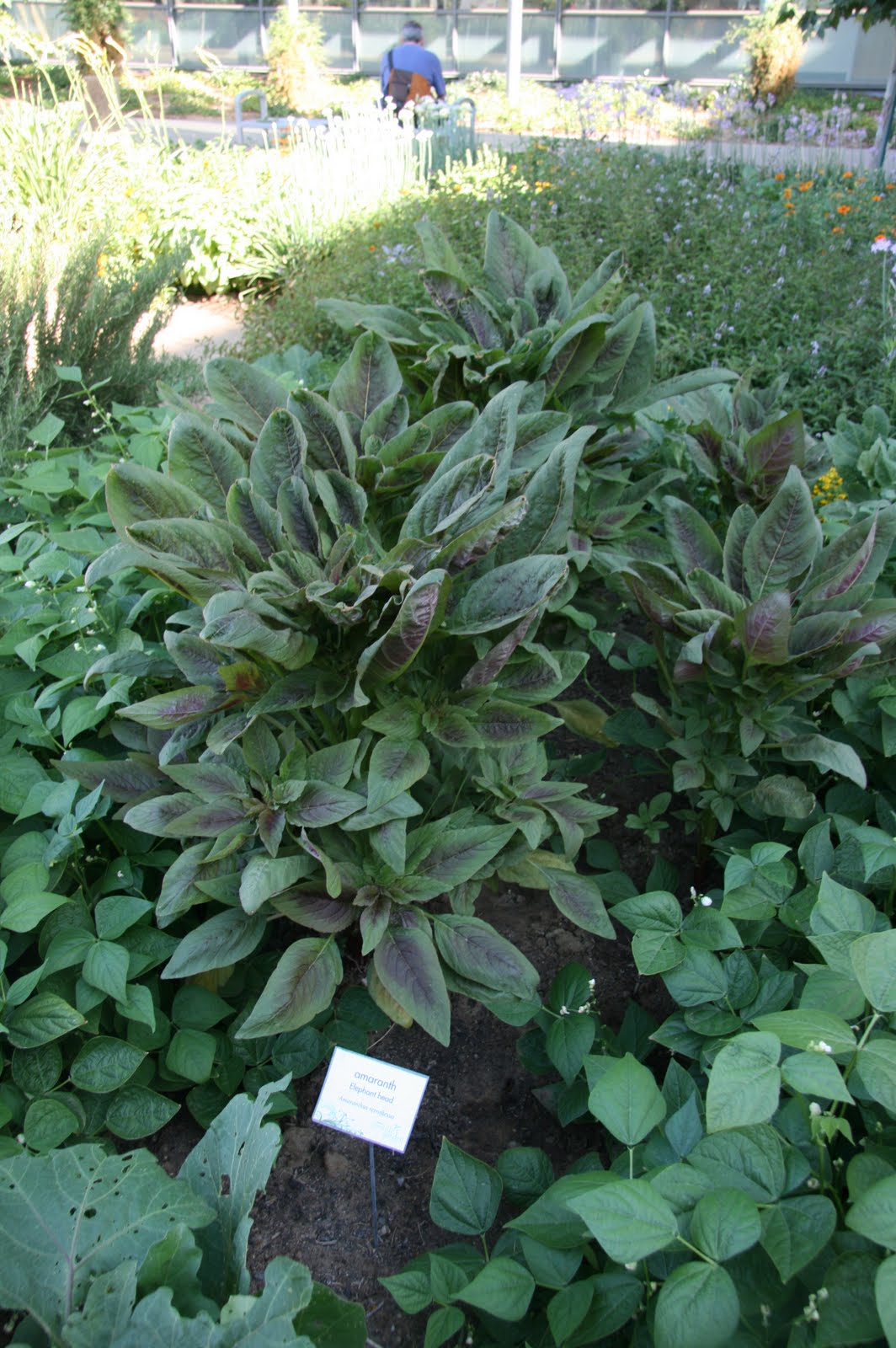
Elephant Head Amaranth


Hopi Red Dye Amaranth


Love Lies Bleeding Amaranth (see photo above with blossoms)


The photo directly above shows how our gardener Arlene is keeping the plants bushy in order for them to produce more greens. Basically she will keep topping the main stalk of the plant. (That white spot in the middle of the photo is the tip of the topped stalk.) This process will slow the plant from sending out the lovely blossoms packed with grain, but at the same time encourages the plant to sprout more of its bushy, tasty leaves.

If you miss sautéeing winter season greens, give amaranth greens a try for the summer and fall!

Wednesday, July 7, 2010

WEBSITE WEDNESDAY! Gardenguides.com for inspiration!


Stumped about where to start with your garden? Want to spruce up your space with a new design or some new plants? Want to try something different? Gardenguides.com is the place to visit!

I stumbled upon this website which came through to my email from google alerts - and what a gem! Not only is it nicely organized and laid out, it has a plethora of ideas to get the creative juices flowing! The "plants" section alone has tons of resources for plants by type, as well as a "top 100 most popular plants" list that links to what seems to be endless resources for each plant on the list. In addition to this they have garden design ideas including links to landscape design resources, how to get started with dry gardens, wet gardens, wildlife gardens, and even how to design a garden by color, light or season. I have to say I'm particularly interested in the moonlight garden plans - who knew there were so many different varieties of flowers that bloom at night! They also have an extensive listing of resources and ideas for edible gardens - even how to make an edible flower salad!

So next time you're stumped or need some inspiration, or even just want some interesting reading accompanied by some lovely photography, check out gardenguides.com!

Friday, July 2, 2010

We're in the News!


Yesterday we were fortunate enough to have a journalist from the The Sac Bee, Gina Kim, and her photographer, Autumn Cruz in our garden to cover our free herb harvest. To see the article online go here, otherwise read what Gina Kim wrote below. Also be sure to take in some of the stunning photos!

Our herb harvests are free and take place every few weeks or so during the summer and fall seasons. Be sure to keep in the loop by signing up for our newsletter, or following are Facebook and/or Twitter accounts. All the information can be found on our website.

In UC Davis courtyard, environment is edible

Leek plants reach up toward the sun. Artichokes peek out from their thistle-like leaves. Fragrant lavender blossoms dry radiantly on their stems.

It's just a routine day in the Good Life Garden at the University of California, Davis.

More than 100 types of flowers, fruits and vegetables have been planted in the 6,000-square-feet of organic growing space in the courtyard of the Robert Mondavi Institute for Wine and Food Science.

The garden is replanted three times a year – fall, spring and summer – and is an example of an edible garden used for decorative purposes.

"People haven't traditionally thought of a tomato plant or basil as landscape plants, but why not? You get something nice to look at and something to eat," said Sal Genito, director of buildings and grounds at Davis.

Those on the garden's e-mail list were invited Thursday to cut lavender and other herbs, the first of the year's monthly harvest days that run through the fall.

Andrea Thompson, 40, of Sacramento came armed with pruning shears and plastic bags. She harvested basil for pesto, garlic chives for scrambled eggs, sage for sweet potatoes and oregano for pasta sauce, plus a bunch of lavender and a bouquet of the daisy-like rudbeckia in yellow and orange.

"It's so motivational for a home gardener to see what's possible," said Thompson, operations director for the school's Foods for Health Institute.

The garden was planted in 2008, the same year the Mondavi institute opened. The second phase of the institute project, a brewery and winery, is expected to be completed this summer.

The garden costs about $45,000 a year to maintain, which Genito hopes to offset soon by selling produce to campus cafeterias as well as renting the space for private events and receptions.

Until a washing facility that complies with food safety standards is installed, most of the produce is donated to the Gunrock Pub and chancellor's events, as well as the Food Bank of Yolo County.

The plants mostly were started from seeds donated by the organic company Seeds of Change, said gardener Arlene Kennedy. Beyond weeding and pruning, Kennedy is also the one who shovels in chicken manure and compost into the beds between the year's three major plantings.

There are generally about 50 plants in the garden at any one time. The summer garden includes seven types of beans, two varieties of thyme, Armenian and lemon cucumber, 10 kinds of tomatoes, four types of eggplants, six varieties of peppers, three kinds of basil and four different lavenders.

Some of the plantings are experimental, like a Fuji apple tree that is being trained to grow like a grapevine for easier picking and space restrictions.

Two persimmon trees are being guided onto a trellis and will eventually be grafted together when they meet. And a handful of tomato plants in new varieties, such as the Pink Berkeley Tie-Dye Heart and Large Barred Boar – developed by the Suisun Valley-based Wild Boar Farms – are starting to sport their fruit.

Each of the garden's beds are a mix of flowers, fruits and vegetables, not just for the aesthetic contrast but because the varieties inadvertently help each other, Kennedy said.

For instance, Persian carpet zinnias attract hoverflies whose larvae eat aphids that feast on the snowy eggplants.

I think organic gardening is easier," Kennedy said. "I let nature resolve the problem."

LEARN MORE

• For more information about Good Life Garden or to get on the newsletter list for harvest day alerts go to www.goodlifegarden.ucdavis.edu.

• The garden is free and open to the public. Contact the Robert Mondavi Institute for Wine and Food Science, (530) 752-6741.

Thursday, May 27, 2010

Container Gardening Question?


We received a question from one of our readers about the safety of gardening in containers and which container material is the best, but we don't have answer. Does our audience have any information to share on the topic? Any advice would be much appreciated! See our reader's question below.

__________________________

I have a very important question and think UCDavis may be the best place to get an answer....
Is it safe to grow vegetables in plastic containers, such as the "plastic" clay colored pots sold at nurseries, and the black gallon or more containers that many plants are sold in? If drinking water from plastic bottles can be dangerous, can this practice be also?
...and how about clay type pots.... how does one know if they contain lead, and if so does in end up in the plants grown in them?
I have been using containers - to grow tomatoes and peppers- for several reasons, mainly to avoid ground critters...but many other folks use them to grow plants on their patios. If using such containers is a heath hazard, it would be kind of you to let us all know.

__________________________

I wish we had an answer from the UC Davis archives, but I was not able to find one! I am sorry we couldn't be more help! You may want to locate a one of your local Master Gardeners and ask them as well. I know that their are quite a few that read our blog, so stay tuned here too!

Monday, May 17, 2010

We're Listed on ALLTOP.com's Gardening Blog Page!

For "Blog Recommendation Monday" we bring you so many gardening blogs from all over that you won't know what hit you! We bring you the Alltop.com gardening page:

ALLTOP.COM GARDENING


Above is a photo of a regal looking blue jay on top of one of a garden trellis. We're not sure why we thought this photo was appropriate for today's entry other than he or she is on top of the trellis, and the UC Davis Good Life Garden is now listed on Alltop.com. It's a stretch, we know!

What the heck is Alltop.com? Well...from one Alltop.com newbie to another (my apologies for waking up to this cool site so recently), this is the place where you can go to find out "what is happening now" on a variety of topics...like gardening. And, when it comes to gardening, UC Davis Good Life Garden is now listed with other really interesting, informative and educational garden bloggers!! We are so excited! You have to scroll all the way to the bottom, but there we are!

Check out all of the sites, you will definitely be bookmarking quite a few for future reference! If and when you do, let us know which you like!

Thursday, May 13, 2010

BEFORE and AFTER: Transition Time!

Doesn't everyone just love before & after photos? I know I do, so that's what we're bringing you today! We are transitioning to our spring/summer edibles in the garden right now! It is a little barren, but we are laying the 'ground' work for a prolific season of yummy produce by amending the soil with compost and Renovate Plus from Earthworks.

Next on our calendar, Arlene will be planting the produce we grow from seed and finally, on May 25, she, along with other UC Davis groundskeepers, will plant the starts we grow at a local nursery as well as the tomatoes that Wild Boar Farms has generously donated!

For now, here are some before and after photos for you to enjoy! Do you have any before and after photos you'd like to share? If so, please post them on our Facebook page!

BEFORE: In the before photo Arlene has just started harvesting the winter produce.


AFTER: This is what it looks like today! Slightly more barren, right?


BEFORE: This is a shot of what our artichokes looked like at the beginning of March.


AFTER: We have pruned the artichokes down to their roots. They will grow back next year! (This one already has started growing back! (Don't you love that ladybug on it!)) Over the spring/summer season okra will be planted here.

BEFORE: Here is our crimson clover patch at the height of its bloom! We planted the clover here to reintroduce the nutrients lost after growing corn in this area last summer.

AFTER: The clover was cut down and tilled back into the earth. This area is again ready to grow corn!

Wednesday, May 12, 2010

Great Gardening Resources: UNIVERSITY OF CALIFORNIA AGRICULTURE AND NATURAL RESOURCES

Here in California we have an amazing resource that I want to make sure you know about! It is known here as ANR or the Division of Agriculture and Natural Resources and is comprised of a statewide network of University of California researchers and educators dedicated to the creation, development and application of knowledge in agricultural, natural and human resources. In other words, they do the research and all you have to do is take advantage of it!

They provide a wealth of information for our farmers, but also our home gardeners. You have got to check some of this out! The books they sell can't be beat, plus they offer a ton of free resources you simply must read!

HOW ABOUT


The California Master Gardener Handbook
It is a whopping 700 pages--the definitive guide to gardening in California. All for only $30!

-or-


Drip Irrigation in the Home Landscape
This easy-to-use reference guide answers common questions about components, materials, design, installation, maintenance, and troubleshooting. If you're considering a drip irrigation system for your garden, for $5 you need this guide -- don't go to the hardware store without it!

-or-

Browse all the FREE PUBLICATIONS from 21 pages about Slugs: A Guide to the Invasive and Native Fauna of California to 6 pages about Patch Budding: A Convenient Method for Top-Working Olives.

Do you have a similar resource in your state? If so, let us know!

Explore, learn and enjoy!

Friday, April 16, 2010

HOP(S) TO IT!

Last year Sierra Nevada Brewing donated the Chinook and Cascade varieties of hops to the UC Davis Good Life Garden to grow in our "Malting and Brewing" demonstration bed.

Hops are a hardy climbing perennial vines that can grow 20-25 feet in a season. We are currently in the process of building a make shift trellis for the vines right now, but it is a race against time as a couple weeks ago they showed no signs of life and now are rapidly crawling up the blue stakes our garden supervisor Ed Nordstrom installed last week!

In beer making the brewer essentially extracts the sugars from barley malt from the hop flowers and then ferments them. The hops, with their bitter oils are used to counter of the sweetness of the fermented malt. Hops are also used as a natural preservative - beer with hops keeps fresher longer.


From what I understand these vines have been known to grow a foot in a day under ideal conditions. They will die back to the crown each fall and hop back again each spring!

BEFORE (A better before photo would just show a brown stump which is what this looked like a couple weeks ago!):

AFTER:


I just love the texture that the leaves have, don't you?

Wednesday, April 14, 2010

Massive Fennel Bulbs!


We've let our fennel go! We planted this fennel last fall! Although it is kind of hard to tell from these photos, these bulbs are really quite large and have started to grow sprout entirely new fennel bulbs! They have not yet started to flower, but when they do, the flowers will provide a nice habitat for bees and butterflies and eventually allow the fennel to self-propagate.

Fennel fun fact: Fennel is a carminative, also known as carminativum (plural carminativa), which is an herb or preparation that either prevents formation of gas in the gastrointestinal tract, or facilitates the expulsion of said gas, thereby combating flatulence.


Here are some tips from eHow on growing the perennial fennel! Did you know that fennel, "Does not play well with others?" The eHow article recommends that you avoid growing fennel near tomatoes, beans and cabbage plants because the fennel interferes with their growth. On the flip side coriander tends to interfere with fennel's growth. We've got our fennel growing with beets and both are doing great!

Monday, April 12, 2010

How Do You Enjoy the UC Davis Good Life Garden?

Many thanks to our first guest blogger, nutritional biology graduate student, Rebecca Tryon Her writing will also be featured in Davis Life Magazine in a new column entitled "Mindful Self Indulgence" beginning with the May 1, 2010 issue.

You can also keep up to date with her thoughtful insights via her own blog Off White Living where she gives her readers a peak into the trials and tribulations involved in ridding her body of a self-described addiction to sugar and flour while still enjoying a good burger!

Rudbekia aka Black-Eyed Susan photo courtesy of Rebecca Tryon.

I happened upon the Good Life Garden last September when I had a seminar class in the RMI building. What a wonderful surprise. As an inspiring gardener and lover of all things veggie, I am always impressed by a garden that weaves natural beauty with function. The Good Life Garden does just that. I recall several afternoons when I’d take my lunch in the garden or go to do some reading, as it was comforting to simply sit in the garden and find some peace amidst my first year of grad school. The garden is always in bloom and it’s been fun to see what changes as the seasons change. It’s a subtle education in seasonal eating.

Naturally, my curiosity about this garden grew. Who tends this garden? Who gets to eat all this great produce? Why doesn’t my garden look anything like this? After asking around a bit I learned that the garden does in fact allow folks to pick the herbs and produce on designated picking days and I was impressed by this. Not only is this garden really lovely to look at and a nice sanctuary to enjoy, it’s also an edible extravaganza for those who become friends of the garden. How cool. I found the garden website and love the interesting recipes, the colorful web display that certainly matches the look of the garden itself.

As a grad student in nutrition and also a huge advocate of community wellness, I see this garden as an example of how it is possible to educate, feed, and inspire people to invite better healthy into their lives. The fact that the garden is also a destination spot for events is also a clever way to provide an aesthetic venue for that also sends a message about health and eating natural foods without being overt.

Unfortunately my own garden did not sustain itself this past year (I just don’t have a green thumb – yet!) but I still get constant reassurance that it is possible to have a thriving garden every time I head to the Good Life Garden. These days I’m happening over there a few times a month to to eat lunch, check out what’s in bloom, attend an event, or take some photos. It’s such a blessing that we have this resource right here on campus and that anybody can enjoy it free of charge. Thanks to the staff who maintain the garden, what a gift you provide!